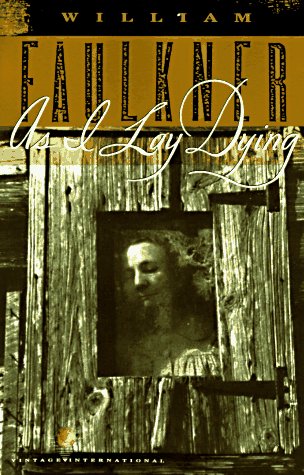
 Addie Bundren has one dying wish--she wants to be buried in her hometown, miles away from the dilapidated farmhouse she resides in with her volatile husband, Anse, and their dysfunctional brood of children. Her family agrees, thinking they will give the long-suffering woman some peace and comfort by fulfilling her request. Truth be told, Addie could care less about returning home. She just wants to punish the family she always despised by tasking them with a grueling quest, which the Bundren journey ends up being, what with raging streams, burning barns, crazy relatives, family secrets, and enough drama to fuel a soap opera.
I haven't been able to read for pleasure lately, so I had to go digging through my archives of reviews. After throwing Kafka at you last week, I hesitated about posting about Faulkner, but it was that or Samuel Beckett. As trippy as Faulkner may be, I assure you Beckett makes Kafka and Faulkner combined seem relatively normal, so I decided to post this review of my favorite Faulkner novel.
I adore Faulkner. One reason is I love his elaborate style, but his work with stream of consciousness and multi POV have greatly influenced me as a writer, and led to a few disastrous Faulknerian writing experiments as a teenager. (Let's not discuss it...) In this novel, Faulkner pieces together the voices of fifteen very different narrators to relate Addie's journey back home, including the dead woman herself. The result is a complex, fascinating work that reads like a puzzle. One is never quite sure what is going on until the very end, so it reads almost like a detective story, yet the solution is learning all about this family wrought with conflict and turmoil. The characters--especially the selfish Anse, stubborn Jewel, sensitive Darl, and enigmatic Dewey Dell--are vivid and memorable. Faulkner employs stream of consciousness technique superbly and crafts a hauntingly realistic portrait of one of literature's most dysfunctional families. I especially love the twist ending. I think it is one of the best ending lines ever written. ^^
Now, as much as I love Faulkner, I will admit: This kind of experimental fiction is certainly not to everyone's taste. As much as I enjoy it, I have to be in the right mood for it. I think it's a mistake to approach this with the same mindset you would a breezy beach read. If you're not willing to process all of the subtle clues Faulkner is giving you, you're going to be extremely confused. And that's the point. You cannot understand the book until you have completed it, so you must be willing to soldier through the whole work. If you look at it like a brainteaser or a puzzle, you'll be in a better frame of mind to appreciate what Faulkner is doing. That being said, I find this book more accessible than Faulkner's other stream of consciousness masterpiece The Sound and The Fury. Once you realize who all the characters are in As I Lay Dying, it's just a matter of following the action, as opposed to The Sound and The Fury. (I had no idea who anyone was until 3/4 of the way through that one.) It also helps to read the book a second time. Then you can concentrate on Faulkner's technique...rather than stumbling through wondering what the heck is going on.
Again, I know this sort of book isn't for everyone. But I highly recommend As I Lay Dying for anyone who likes experimental fiction. If you have never sampled any of Faulkner's stream of consciousness work, this book is not quite as intimidating as some of his other pieces. Give it a chance and tell me what you think. (I will still be friends with you if you throw the book at the wall and curse me for recommending it.)
~
Next Week: I am so sorry, but I just have no idea. I am trying to get something read for you guys! My coworker recommended a literary, alternative fantasy series about a book detective. I would like to try that, but I make no guarantees. I'll find something!
Also, Scott and Serena made eloquent pleas for mercy for "The Unblogged Chronicles". I still haven't made up my mind, but I am not entirely considering axing it now. I will make some changes, but for now, they will still be posted.
One more thing! Shmoop posted a book link in honor of Yom HaShoah--Holocaust Remembrance Day. Those of you who know me know I am very proud of my Jewish heritage. And, as a history major who plans to specialize in Nazi Germany, I am a firm believer in the old refrain: Those who do not learn from history are doomed to repeat it. I know the Holocaust is not a very pleasant event to remember, but it is something that can't go unmentioned. I would have posted a book review of an appropriate read but, alas, I didn't have time. But, still, read Elie Wiesel's Night or Anne Frank's Diary of a Young Girl or Markus Zusack's The Book Thief or Richard Glazar's Trap with a Green Fence this week. Maybe next year, I'll have an appropriate review, like Corrie Ten Boom's The Hiding Place or, if I can ever get a hold of an English translation, Lovely Green Eyes. Thanks...and shalom. :)


