Showing posts with label family drama. Show all posts

21 January 2011

A Streetcar Named Desire

Blanche DuBois has problems, to put it mildly. She has lost her beloved Mississippi plantation Belle Reve and is now forced to live in squalor in New Orleans' French Quarter with her younger sister Stella and Stella's brutal, animalistic husband Stanley Kowalski. The fragile Blanche, who has a tenuous grasp on reality as is, is determined to make her surroundings as refined as possible, though she soon learns that doing so while sharing living quarters with the uncouth Stanley is nearly impossible. Things soon degenerate as Blanche and Stanley become locked in a battle of wills against each other, with Stella trapped in the middle. Then, Stanley learns perhaps why his flighty, neurotic sister-in-law lost Belle Reve and is prepared to stop at nothing to gain the upper hand over her. And when I say stop nothing, I do mean nothing . . .

A Streetcar Named Desire is one of my favorite plays. Some of you may recall that back in 2009, I debated for a long time over whether or not to review this play or playwright Tennessee Williams' other masterpiece The Glass Menagerie. I ultimately decided on The Glass Menagerie, but I reread Streetcar for my American Lit 2 class last semester and SweetTart-Girl asked me if I'd do a review, seeing as she'll be studying it this semester in one of her classes. *Zella waves magic wand and grants wish because she fancies herself as a book genie* :D

This play is a masterpiece of dramatic tension, as Blanche and Stanley face off constantly over every petty scenario known to man. I think the tension rings true just because it is so realistic. Even if your family does get along well, who hasn't had a family argument turn nuclear over something inanely stupid? Despite Williams' effective use of tension, this play is still primarily a character-centric work, not plot-driven. All of the characters, except for maybe Blanche's potential love interest Mitch, are grotesque and troubled. It's hard to find one character to unequivocally root for, which is why I think some readers dislike the play. Even though Blanche is the main character and is quite pathetic, she's far from a traditional heroine. I like complex characters, so for me, the fact that there is no clear-cut good guy (though Williams clearly intends for us to sympathize with Blanche, even if we don't understand or agree with her) is a plus.

I am a hug fan of reading plays, but plays were still written with the intention of being performed. Soooo . . . your Streetcar experience will not be complete unless you watch the 1951 film version with Marlon Brando and Vivien Leigh. You must watch this one! Brando originated the part of Stanley on stage. It's what made him contender! I am making you an offer you can't refuse! Who me? An obsessive Brando fan? Erm . . . maybe. (Bonus points if you recognized the two Brando quotes in this paragraph.) But the original film version is easily the best, if not just because all of the actors are so good. I will warn you that even though the film version stays remarkably close to the play, the ending was changed to appease movie censors, who demanded that the bleak tragedy had to have some redeeming value.
If you're looking for complex characters and an intense story line, definitely read A Streetcar Named Desire. This play is one of the most famous written in the past sixty years . . . and for good reason, in my opinion. Not to mention that reading it is the perfect excuse to indulge in a Brando marathon afterwards. ^^
~~~~
Next Time: Art Spiegelman's Maus.
~~~~
This Week in Literary History: 27 January 1302 Political enemies exile Dante Alighiere from Florence. Though this may have seemed like a bad thing for Dante at the time, his banishment ended up being a good thing for literary history, for he wrote his masterpiece The Divine Comedy during this period.
~~~~
Announcements: I dole out some blogging awards on my second blog, so stop by. You may have an award waiting for you. :)

14 April 2010

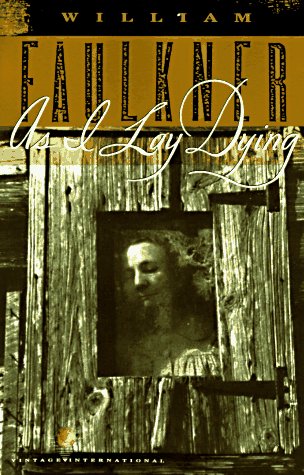
As I Lay Dying

Addie Bundren has one dying wish--she wants to be buried in her hometown, miles away from the dilapidated farmhouse she resides in with her volatile husband, Anse, and their dysfunctional brood of children. Her family agrees, thinking they will give the long-suffering woman some peace and comfort by fulfilling her request. Truth be told, Addie could care less about returning home. She just wants to punish the family she always despised by tasking them with a grueling quest, which the Bundren journey ends up being, what with raging streams, burning barns, crazy relatives, family secrets, and enough drama to fuel a soap opera.

I haven't been able to read for pleasure lately, so I had to go digging through my archives of reviews. After throwing Kafka at you last week, I hesitated about posting about Faulkner, but it was that or Samuel Beckett. As trippy as Faulkner may be, I assure you Beckett makes Kafka and Faulkner combined seem relatively normal, so I decided to post this review of my favorite Faulkner novel.
I adore Faulkner. One reason is I love his elaborate style, but his work with stream of consciousness and multi POV have greatly influenced me as a writer, and led to a few disastrous Faulknerian writing experiments as a teenager. (Let's not discuss it...) In this novel, Faulkner pieces together the voices of fifteen very different narrators to relate Addie's journey back home, including the dead woman herself. The result is a complex, fascinating work that reads like a puzzle. One is never quite sure what is going on until the very end, so it reads almost like a detective story, yet the solution is learning all about this family wrought with conflict and turmoil. The characters--especially the selfish Anse, stubborn Jewel, sensitive Darl, and enigmatic Dewey Dell--are vivid and memorable. Faulkner employs stream of consciousness technique superbly and crafts a hauntingly realistic portrait of one of literature's most dysfunctional families. I especially love the twist ending. I think it is one of the best ending lines ever written. ^^

Now, as much as I love Faulkner, I will admit: This kind of experimental fiction is certainly not to everyone's taste. As much as I enjoy it, I have to be in the right mood for it. I think it's a mistake to approach this with the same mindset you would a breezy beach read. If you're not willing to process all of the subtle clues Faulkner is giving you, you're going to be extremely confused. And that's the point. You cannot understand the book until you have completed it, so you must be willing to soldier through the whole work. If you look at it like a brainteaser or a puzzle, you'll be in a better frame of mind to appreciate what Faulkner is doing. That being said, I find this book more accessible than Faulkner's other stream of consciousness masterpiece The Sound and The Fury. Once you realize who all the characters are in As I Lay Dying, it's just a matter of following the action, as opposed to The Sound and The Fury. (I had no idea who anyone was until 3/4 of the way through that one.) It also helps to read the book a second time. Then you can concentrate on Faulkner's technique...rather than stumbling through wondering what the heck is going on.

Again, I know this sort of book isn't for everyone. But I highly recommend As I Lay Dying for anyone who likes experimental fiction. If you have never sampled any of Faulkner's stream of consciousness work, this book is not quite as intimidating as some of his other pieces. Give it a chance and tell me what you think. (I will still be friends with you if you throw the book at the wall and curse me for recommending it.)
~

Next Week: I am so sorry, but I just have no idea. I am trying to get something read for you guys! My coworker recommended a literary, alternative fantasy series about a book detective. I would like to try that, but I make no guarantees. I'll find something!

Also, Scott and Serena made eloquent pleas for mercy for "The Unblogged Chronicles". I still haven't made up my mind, but I am not entirely considering axing it now. I will make some changes, but for now, they will still be posted.

One more thing! Shmoop posted a book link in honor of Yom HaShoah--Holocaust Remembrance Day. Those of you who know me know I am very proud of my Jewish heritage. And, as a history major who plans to specialize in Nazi Germany, I am a firm believer in the old refrain: Those who do not learn from history are doomed to repeat it. I know the Holocaust is not a very pleasant event to remember, but it is something that can't go unmentioned. I would have posted a book review of an appropriate read but, alas, I didn't have time. But, still, read Elie Wiesel's Night or Anne Frank's Diary of a Young Girl or Markus Zusack's The Book Thief or Richard Glazar's Trap with a Green Fence this week. Maybe next year, I'll have an appropriate review, like Corrie Ten Boom's The Hiding Place or, if I can ever get a hold of an English translation, Lovely Green Eyes. Thanks...and shalom. :)

27 December 2009

The Glass Menagerie

The Wingfield family is in sad shape. Domineering mother Amanda clings to memories of her aristocratic Southern childhood, perhaps to block out her impoverished life in a St. Louis slum after being abandoned by her husband. Her son, Tom, feels trapped and has become bitter. He hates his boring warehouse job and seeks escape in late night movies and D.H Lawrence novels. His emotionally fragile, disabled sister Laura has withdrawn into her own private world, which centers on her collection of glass figurines (The menagerie of the title.) Amanda decides that the only way the painfully shy Laura will ever be able to amount to anything is to marry well, so the willful mother badgers Tom into inviting a friend over to help coax Laura out of her shell. If only Amanda knew what devastation this plan ultimately brings...

Tennessee Williams' classic drama The Glass Menagerie is a moving exploration of shattered dreams and shattered families. As you may recall from last week, I had a hard time choosing between this play and Williams' other classic, A Streetcar Named Desire. I still debated over which one to do to the last minute, but I ultimately decided on this play because, as much as I love A Streetcar Named Desire, I think this play offers a more satisfying reading experience. (On the other hand, reading A Streetcar Named Desire is great, but watching it is even better. Watch the 1951 version with Brando. I am not just biased because I think he's the greatest actor ever, well, maybe just a little. If you've never seen it, go watch it now!)

I thoroughly enjoyed The Glass Menagerie. This play, unlike many others, does not rely on convoluted plot devices or outrageous scenarios. Instead, it focuses on a very authentic situation and advances its plot based on dramatic tension. I know that's not every one's cup of tea, but this play is masterfully crafted and never once did it lose my interest. Furthermore, at less than 100 pages long, it's easily read in one setting. The characters are also so realistically drawn that's impossible to not relate to them. Growing up in the South, I have met my fair share of Amandas (some even in my own family) and their smothered offspring; consequently, I found Amanda the most interesting character, even though Tom's the narrator and Laura's the centerpiece. I especially liked the interactions between Amanda, Laura, and Tom. Their petty disputes and heated arguments are something anyone with family will relate to and, even more importantly, their relationships ring true. Williams based all of these characters on members of his own family, and I believe that adds to the realism. Finally, I was pleased with the dialogue - the Southern dialect is perfect. This is something I am nitpicky about, but Williams nailed it perfectly, everything from the sentence structure to the frequent insertions of "honey, " especially when employed after an insult...

My only problem with this play is some of the stage directions. Williams intended this as a "memory" play, in which the scenes are presented as distorted by the human memory, rather than as fact. The result is a dreamy atmosphere that, for the most part, I found effective. However, the stage directions also call for the use of a screen to flash images and text throughout the play. Although occasionally the instructions were amusing, for the most part, I found this distracting. Williams conveys so much through plot and dialogue, so I didn't see why this was needed at all. Most directors of the play seem to concur, since this element of the play is usually not seen when staged, even when the play was first released in the 1940s.

I am a firm believer that, though plays are fun to read, they are still best experienced in their intended state - as performed drama. Sadly, I have never seen The Glass Menagerie performed. It's a popular play, so you may be able to catch it at a local theater. If not, you could watch one of the several film/TV versions available. The best known is probably the 1987 version, directed by Paul Newman. I have never seen it, but I read that it is a faithful adaptation. Critics, however, squabble over the quality of the acting.

The Glass Menagerie is a compelling combination of family drama, tragedy, and Southern Gothic. Easy to read and achingly authentic, this play is a great way to while away a winter afternoon. The Glass Menagerie is one of the most renowned post-WWII American plays and is well worth your time.

~

Next Time: I will be reviewing Erich Maria Remarque's classic war novel All Quiet on the Western Front. I love the acclaimed movie that is inspired by this novel and bought myself a copy of the book with my Hanukkah money. (Yay!) I was trying to decide what to read next and Scott voted for this one. I am over halfway through the book, have enjoyed every bit of it, and should have a review up soon.