14 April 2010

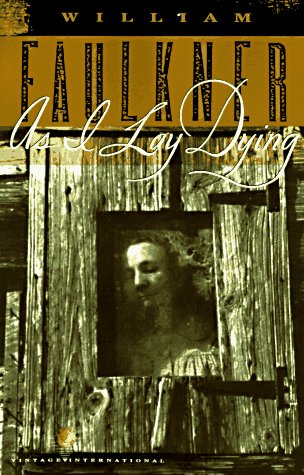
As I Lay Dying

Addie Bundren has one dying wish--she wants to be buried in her hometown, miles away from the dilapidated farmhouse she resides in with her volatile husband, Anse, and their dysfunctional brood of children. Her family agrees, thinking they will give the long-suffering woman some peace and comfort by fulfilling her request. Truth be told, Addie could care less about returning home. She just wants to punish the family she always despised by tasking them with a grueling quest, which the Bundren journey ends up being, what with raging streams, burning barns, crazy relatives, family secrets, and enough drama to fuel a soap opera.

I haven't been able to read for pleasure lately, so I had to go digging through my archives of reviews. After throwing Kafka at you last week, I hesitated about posting about Faulkner, but it was that or Samuel Beckett. As trippy as Faulkner may be, I assure you Beckett makes Kafka and Faulkner combined seem relatively normal, so I decided to post this review of my favorite Faulkner novel.
I adore Faulkner. One reason is I love his elaborate style, but his work with stream of consciousness and multi POV have greatly influenced me as a writer, and led to a few disastrous Faulknerian writing experiments as a teenager. (Let's not discuss it...) In this novel, Faulkner pieces together the voices of fifteen very different narrators to relate Addie's journey back home, including the dead woman herself. The result is a complex, fascinating work that reads like a puzzle. One is never quite sure what is going on until the very end, so it reads almost like a detective story, yet the solution is learning all about this family wrought with conflict and turmoil. The characters--especially the selfish Anse, stubborn Jewel, sensitive Darl, and enigmatic Dewey Dell--are vivid and memorable. Faulkner employs stream of consciousness technique superbly and crafts a hauntingly realistic portrait of one of literature's most dysfunctional families. I especially love the twist ending. I think it is one of the best ending lines ever written. ^^

Now, as much as I love Faulkner, I will admit: This kind of experimental fiction is certainly not to everyone's taste. As much as I enjoy it, I have to be in the right mood for it. I think it's a mistake to approach this with the same mindset you would a breezy beach read. If you're not willing to process all of the subtle clues Faulkner is giving you, you're going to be extremely confused. And that's the point. You cannot understand the book until you have completed it, so you must be willing to soldier through the whole work. If you look at it like a brainteaser or a puzzle, you'll be in a better frame of mind to appreciate what Faulkner is doing. That being said, I find this book more accessible than Faulkner's other stream of consciousness masterpiece The Sound and The Fury. Once you realize who all the characters are in As I Lay Dying, it's just a matter of following the action, as opposed to The Sound and The Fury. (I had no idea who anyone was until 3/4 of the way through that one.) It also helps to read the book a second time. Then you can concentrate on Faulkner's technique...rather than stumbling through wondering what the heck is going on.

Again, I know this sort of book isn't for everyone. But I highly recommend As I Lay Dying for anyone who likes experimental fiction. If you have never sampled any of Faulkner's stream of consciousness work, this book is not quite as intimidating as some of his other pieces. Give it a chance and tell me what you think. (I will still be friends with you if you throw the book at the wall and curse me for recommending it.)
~

Next Week: I am so sorry, but I just have no idea. I am trying to get something read for you guys! My coworker recommended a literary, alternative fantasy series about a book detective. I would like to try that, but I make no guarantees. I'll find something!

Also, Scott and Serena made eloquent pleas for mercy for "The Unblogged Chronicles". I still haven't made up my mind, but I am not entirely considering axing it now. I will make some changes, but for now, they will still be posted.

One more thing! Shmoop posted a book link in honor of Yom HaShoah--Holocaust Remembrance Day. Those of you who know me know I am very proud of my Jewish heritage. And, as a history major who plans to specialize in Nazi Germany, I am a firm believer in the old refrain: Those who do not learn from history are doomed to repeat it. I know the Holocaust is not a very pleasant event to remember, but it is something that can't go unmentioned. I would have posted a book review of an appropriate read but, alas, I didn't have time. But, still, read Elie Wiesel's Night or Anne Frank's Diary of a Young Girl or Markus Zusack's The Book Thief or Richard Glazar's Trap with a Green Fence this week. Maybe next year, I'll have an appropriate review, like Corrie Ten Boom's The Hiding Place or, if I can ever get a hold of an English translation, Lovely Green Eyes. Thanks...and shalom. :)

07 April 2010

The Metamorphosis

I am sure we've all had one of those mornings where nothing worked out right: Your alarm doesn't go off, your car won't start, and your breakfast ends up on your only clean outfit. (Please tell me it's not just me with the crazy mornings!) Well, as crappy as all of our days can be on occasion, we can at least take solace in the fact that we've never awakened to discover that we've turned into a gigantic beetle overnight (or at least I hope we can take solace in this), which is exactly what happens to Gregor Samsa, the protagonist of Franz Kafka's eerie classic The Metamorphosis.

I adore Kafka's work, especially his short stories, and this novella is one of my favorites. As a reader, his recurring theme of alienation has always struck a chord with me; as a writer, his superb craftsmanship has always been an inspiration to me. I also find his personal story one of literature's most quietly tragic (Poor lonely Franz...), but that's a story for another post. I love the way Kafka combines mundane reality with out-of-this world fantasy, which is certainly showcased in The Metamorphosis. One of the main reasons I love this story is that Kafka never explains why Gregor is turned into a bug. I think that would have ruined this story, because, really, the fact that he is a bug is one of the least of his problems, though it does complicate things. Kafka, instead, focuses his attention on the fall-out from Gregor's change, and the result is a tragic, absurd, disturbing allegory, though exactly what Kafka is allegorizing is fodder for endless debate.

Gregor is a somewhat pathetic character that I can't help pitying, but his dysfunctional family and their reactions to his state are also key components of this story--ones that are both amusing and heartbreaking. Their vain attempts to cope with Gregor's transformation forms a vital crux of this novel, particularly the ever-present alienation theme. The tragicomic interactions between Gregor and his relatives, and the world around him in general, are the highlight of this story, precisely because they ring true. I also love the surreal atmosphere that Kafka creates with his droll, meticulous style. This novella amuses me, saddens me, and creeps me out all at once. I never can read it without getting that creepy-crawly feeling I get when a bug crawls on me. (I have to read this several times this week for lit. to prepare for quizzes. This is making my homework sessions memorable...)

Though I love this story, I will admit: It's weird. It may be a bit too weird for everyone's personal taste. (I once read a comment on Sparklife that said certain things just should not be thought up. And Kafka's The Metamorphosis was one of them.) I disagree with the aforementioned sentiment--obviously. I love the originality of Kafka and think the uniqueness of his work is the point. But I can't deny that his work, and this story in particular, won't freak you out.

I highly recommend Kafka's The Metamorphosis, if only because the premise is so innovative and the execution of it is so masterful. Kafka is one of the premier voices in modernist literature...and for good reason. If you've never read Kafka before, this thirty page novella is the perfect introduction.

~

Next Week: Not sure. My schedule is going to get crazy. Maybe a review. Maybe a list. We'll see. If it is a list, it will probably be a list of the books I'd want with me if I were shipwrecked.

However, as busy as I will be, you can catch up with me at my second blog: Grammatically Motivated. I have been meaning to start a second blog, to post non-book related articles, but haven't had time. My faulty logic is that now that I am going to have limited time, it may be easier to write articles that don't require me to read ahead of time. Tis the theory, anyway...

Also, I am thinking about ending "The Unblogged Chronicles". I have been disappointed with this series. I think they're too long without being in-depth enough and lack a unifying theme. Therefore, I am considering halting that series. Any thoughts? Want me to kill the "Chronicles" or do you request mercy?

Don't forget: I can pester you on Twitter now. :D 

31 March 2010

The Unblogged Chronicles (March 2010)

This is another installment of "The Unblogged Chronicles"--mini reviews of all of the books I didn't blog about this month. Enjoy!

The Joy Luck Club (family drama/women's fiction): I have been meaning to read this book, which has become something of a modern day classic, for some time now. This Amy Tan novel tells the story of four immigrant Chinese women and their Americanized daughters through touching vignettes that range from tragic to comedic. As you all well know, I am a huge fan of works that feature multi POVs, and this novel alternates between first person narration from all of the daughters and three of the mothers. The result is a fascinating book with a plot that unravels like a puzzle as you follow each character's development and motivation. This novel isn't packed full of action, per se, but it is an enthralling story anyway. Tan writes an intriguing domestic drama that anyone with relatives can relate to. I look forward to reading more of her work.

Hedda Gabler (tragedy): This Henrik Ibsen drama was part of my assigned reading for World Literature II this semester and is considered one of the classics of modern drama...for good reason. I adored this play--it's a fun read. The protagonist, Hedda, is a fiery, complex female character with a dark side, and this tragedy, which traces her downfall in the course of two days, is superb. All of the characters are well-crafted (Ibsen took one year to plan out their personalities. As a details-obsessed neurotic, I appreciate an author who is obssesive with research.) The Victorian Scandinavian setting is vivid and realistically portrayed, as well. I really wanted to do a blog post on this one, but, alas, I was too busy studying it for a test to have time. Waaa! On the flip side, this play is a lot of fun to analyze in class. ^^

Peony in Love (romance): All right, I must be honest: I have mixed feelings about romances. On one hand, I adore certain classic romances, gothic romances, and historical romances. On the other hand, I am not a big fan of the Happily Ever After endings that are so common in this genre. Meh, I just think they are a bit too pat. Give me a choice between a Happily Ever After and a murder-filled finale where everyone dies, and I'll choose the bloodbath every time. I found this Lisa See novel--a supernatural romance set in 16th century China and loosely based on fact--interesting, though a few parts did drive me a little crazy. (Not crazy enough to make me dislike the book, but crazy enough to make me occasionally roll my eyes.) This novel is the tale of Peony, who pines away from lovesickness, under the influence of the deeply romantic and frequently banned The Peony Pavilion opera, and, after becoming a ghost, influences her husband's subsequent brides to do likewise. The first part, before Peony's death, is good, but it's all very familiar: Girl falls in love with dreamy boy. Girl is trapped in impending arranged marriage and will never see boy again. Girl becomes upset and starts acting crazy. (On a side note: If you decide to go on secret rendezvous with an attractive stranger, please, for the love of God, at some point tell each other your names. It will save everyone a lot of heartbreak, okay? Thank you. This has been a public service announcement by Zella Kate, courtesy of the Lonely Hearts' Club.) I thought that the book improved dramatically after Peony died and became a ghost, primarily because it was unique and provides a fascinating look at traditional Chinese beliefs about the afterlife. The historical detail is well done. Overall, I liked the book, though I thought the beginning was a bit clichéd.

Secrets of Eden (literary thriller): Alice Hayward was baptized on Sunday morning. She was murdered by her abusive husband in a murder-suicide on Sunday night. But was it really a murder-suicide? Evidence at the crime suggests it may have been a double homicide and the pastor that baptized Alice, Stephen Drew, is the prime suspect. This brand new Chris Bohjalian novel is told through the POVs of the accused Drew, the DA who believes he's harboring secrets, an author who interjects herself into the investigation because her parents also died in a murder-suicide, and Alice's now orphaned daughter. The only reason I didn't review this is it would have come too soon after Shutter Island. This is an extremely well-written novel. Bohjalian does a marvelous job of maintaining suspense without resorting to overdone plot tricks. I was particularly impressed with how individual each of the character's narration was, especially the sardonic DA, Catherine, and Alice's teenage daughter, Katie. I highly recommend this book.

Gone, Baby, Gone (hardboiled mystery): I am now a confirmed Lehane nut. Aly simultaneously recommended it to me as I was reading it. (You know what they say about great minds...) This is a gritty, heartrending tale of a kidnapping in the mean streets of Dorchester, Massachusetts and the resulting investigation by private detectives Patrick Kenzie and Angela Gennaro. As with Shutter Island, I loved the twisty plot and the great characters. I also love how Lehane doesn't cop out and go for the blatantly unrealistic happy ending. As with my other Lehane review, I must warn you that this also has loads of profanity and some very disturbing scenes. (If it makes a hardened PI like Patrick cry, it will make you bawl, too. Or at least it made me cry.) My only problem, and it isn't the author's fault, is it is a little hard to follow in parts because this is the fourth book in a series, but Lehane keeps it up to date without bogging you down in details. (I am now going insane trying to find the other books in the series.)

Prayers for Rain (hardboiled mystery): This is the fifth Lehane novel about Gennaro and Kenzie. (I am reduced to reading whichever one I can get my hands on. Pity me! Pity me!) I enjoyed this one--which details the detectives investigation of a sadistic stalker who pushes his victims to commit suicide--but I liked Gone, Baby, Gone just a little better. Reason is in this one the basic plot gets figured out before the denouement and it becomes more an issue of stopping the stalker, rather than a mystery right down to the end. It’s still a great atmospheric read with Lehane’s trademark sardonic wit. And the ending, where Kenzie and Gennaro turn the tables on the stalker, is delicious revenge. *insert standard disclaimer about profanity and adult situations*

Columbine (non-fiction/true crime): The Columbine High School shooting was the first major news story that I remember when it happened. (The fact that I was living in Colorado at the time probably didn't help.) As with true crime in general, it is an event that both horrified and fascinated me. Eleven years after the fact, journalist Dave Cullen re-examines the massacre in this meticulously researched, well-written book that explodes many of the myths about the tragedy. I saw a review that compared it to one of my favorite books--Truman Capote's In Cold Blood. That's high praise from anyone, but this book is reminsicent of Capote's masterpiece. Even the killers bear a disturbing resemblance to the murderers in Capote's book. (That's because murder-spree duos usually have similar psychological mindsets, but that's a story for another day.) Cullen is widely regarded as a foremost authority on the Columbine school shooting. This book proves it.

Greedy Apostrophe (children’s book): Those of you who know me well know that I love punctuation, even to the point of committing vandalism in the name of preserving proper punctuation. *cough* You also know that I adore that most special yet maligned punctuation mark: the apostrophe. *gently picks apostrophe up and holds her high for the world to behold* Is she not dainty and pretty? Is she not flawless? Is she not the epitome of what a punctuation mark should be? (Just agree with me. Please.) Well, as much as I adore the apostrophe, in the wrong hands, this gentle soul can wreak havoc. Greedy Apostrophe: A Cautionary Tale, by Jan Carr, warns of the confusion and horror that can result from abuse of the apostrophe. This is a children's book, so I wouldn't expect you guys to read it, but for those of you with younger relatives, please read this book to them! Alert them to the dangers inherent in using apostrophes to make something plural! Greedy Apostrophe must be stopped! We need your help! :P

P.S. As some of you have already discovered, I am now on Twitter. Stop by and read the ramblings of my diseased mind when you get a chance...if you dare. :)

~

Next Week: Franz Kafka's The Metamorphosis. This is one of my absolute favorite stories from one of my favorite writers. We're reading it for World Lit this semester. I squealed with joy when I saw it on the syllabus.