Showing posts with label fantasy. Show all posts

07 August 2011

Miss Peregrine's Home For Peculiar Children


For the time being, life sucks for teenager Jacob Portman. Oh, sure, he comes from a wealthy Florida family and wants for nothing, but he's recently been depressed lately. And who wouldn't be? He found his eccentric grandfather viciously mauled to death by dogs. Problem is, Jacob knows his grandfather didn't die that way. His grandfather was actually killed by monsters, a reflection of the strange childhood the former used to tell Jacob about when he was younger, a childhood that involves a strange school on a secluded Welsh island that housed children who were invisible or capable of levitating. Of course, try telling the true story to anyone, and you get shipped off rather promptly to a shrink, which is exactly what happens to Jacob. Fortunately for his own peace of mind, he is able to connive a visit to the island his grandfather talked about to prove to himself whether or not the older man's stories had any basis in fact. There, he discovers that his grandfather's seemingly fictional tales are very real. . . .

I came across this unique young adult book while working at the library. One of my coworkers was reading about it on Amazon. We both were attracted to the creepy cover, so she ended up reading it. She told me the book wasn't spectacular but was undeniably weird. Naturally, I couldn't resist giving it a try. Ransom Riggs's Miss Peregrine's School For Peculiar Children is an uneven book with its share of flaws, but it is certainly unique and has enough good points that I recommend it.

After discussing this book with two other people who have read it, all three of us concurred that the best adjective for it is, ahem, "peculiar." It's not scary--Don't fear! This book will not give you nightmares--but it is certainly eerie. This haunting gothic atmopshere is exactly why I recommend it. The creepy gothic pictures that accompany the text play a substantial role in creating this atmosphere. In fact, even if this book isn't your cup of tea, I recommend checking it out just to look at the pictures, which range from levitating girls to creepy clown children. They are that good! Apparently, Riggs used actual old photos that he found in various collectors' stashes and then worked the images into the story. Overall, I thought he did a fairly good job of working random pictures into a a fairly cohesive plot. Occasionally, the plot did seem a little contrived--as if there were certain pictures that Riggs wanted to include just because they were so cool; thus, he added a related element in the story. Nevertheless, the effect more than makes up for this problem.

Personally, I had a bit of a hard time liking Jacob. Oh, he's not awful, not by any stretch of the imagination. He's just like every other somewhat sarcastic troubled YA hero I've met lately. I would have liked someone with a little more depth and individuality. The person he reminds me most of is Percy Jackson--more on that in a minute--but I found Percy a little more accessible. Jacob's first person narration is still pretty funny, though, and I don't necessarily have to like the protagonist to enjoy a book.

My only real complaint with the book is that about midway through, the story transitions from a good dark gothic horror/mystery story to a run-of-the-mill fantasy adventure, a la Percy Jackson. I like a good fantasy adventure, such as the aforementioned Percy Jackson series, but I was enjoying the gothic aspects of the story, so I felt a little cheated when the tone switched. To the book's credit, it's action-packed fantasy adventure with its own unique spin on the genre.

The ending leads me to believe that a sequel in the works, but I can't find anything to confirm that on the internet. I'm not sure the story is quite strong enough to generate a YA series, but I'll withhold judgment until I read any sequels. Riggs is certainly a creative writer with an eye for the eccentric, so I don't doubt that any follow-up would be equally as whimsical and strange . . . and feature just as many amazing photos! ^^

If you like gothic horror or are hankering for another fantasy adventure read now that Percy Jackson's series is at an end, I recommend Miss Peregrine's School For Peculiar Children. It's certainly not a book for everyone, but it has its charms, one being that it's a quirky fast-paced read, perfect for summer! At the very least, pick it up and skim the pictures. I kid you not--they are delightfully creepy.
~~~~
Next Time: I have no idea.
~~~
This Week In Literary History: 5 August 1850: French writer Guy de Maupassant is born. Truth is, I've only read one of his stories--"The Necklace"--but it's such a good short story! You should definitely read it if you never have.

21 April 2010

The Eyre Affair

Imagine the year 1985 in a world where the Crimean War still rages on, time travel is possible, book worms exist (Get it? Get it?), and the British public can't get enough of literature and art. Rabid Baconians stalk the street, proselytizing that Francis Bacon wrote the amazing plays attributed to Shakespeare; militant surrealists are murdered by rogue impressionists on the streets of London; and the novel Jane Eyre ends with Jane marrying that twit cousin of hers and leaving Mr. Rochester to a sad life all alone. (How dare she! Poor lonely Eddie...) In this chaotic world, a market exists for bootlegged manuscripts of classic novels, which is exactly what SpecOp agent Thursday Next battles on a day-to-day basis. The brainy but troubled Next is used to hunting down forged copies of Johnson and Austen. What she is not used to is maniacal criminals like Acheron Hades entering into books to kidnap and murder beloved literary characters. When Hades kidnaps Jane, it is up to Thursday, her partner, and Mr. Rochester himself to rescue Jane and make the world safe for classic literary characters everywhere.

My coworker Darcie recommended this delightful book--The Eyre Affair--to me; when I hinted at reviewing this book last week, Serena not only correctly guessed the title, she also recommended the book as well. When one reader with great taste in books suggests a book to me, I always get excited. When two readers with great taste in books suggest a book to me, I cannot resist. Thank you both so much! I loved this book and can't wait to read the rest of this series.

One reason I loved this book was the pithy British sense of humor that author Jasper Fforde brings. His witty style and outrageous plots remind me of some weird fusion of Terry Pratchett, Monty Python, and Lynne Truss. (It also reminds me of my beloved TV show Pushing Daisies. It has the same darkly funny mix of humor and escapist fantasy. Random Zella tangent: I will never, ever forgive ABC for cancelling Pushing Daisies. If ABC is reading this: I have not forgotten that retaliation riot I threatened. Consider yourself warned.) I am especially impressed with the skill that Fforde handles a plot that could very easily be dismissed as too silly. Instead, he crafts a gripping thriller and a sharply humorous alternative universe that is not so very different from our own, yet is worlds away, in a good way. The characters are likeable, quirky, and complex, especially Thursday, who is a truly wonderful heroine. She's neither a pathetic damsel in distress nor an over-the-top action heroine stereotype, both of which I despise in fiction. I also enjoyed the twisting plot that features elements of several genres. Sci fi, fantasy, mystery, alternative history, and humor fans will all find something to love here. Fforde puts clever twists on timeworn cliches from each genre, which helps add to the inventive tone.

However, the real draw will be for those who love classic literature. That's not really a prerequisite to reading and enjoying this book--it certainly stands alone--but this book will definitely be more appealing to those who have read and loved Jane Eyre and those who recognize all of the literary allusions that Fforde inserts within the text. (My favorite is Thursday's Uncle Mycroft. I named my laptop after Mycroft Holmes, Sherlock's older brother, a couple of years ago. I had a moment of extreme nerdy happiness when I read Mycroft's name in this book..)

If you're looking for a light-hearted, clever, and highly original read, of either the spec fic or literary variety, try The Eyre Affair. Jasper Fforde is a talented writer with a highly original outlook on fiction. Beware, though: You may find yourself scrambling to find his other books, just like Darcie, Serena, and myself.

~

Next Week: Um, I have no idea. Maybe some Cormac McCarthy. Or a YA thriller set in World War II. Or Treasure Island. I have no earthly idea. Don't look at me! *hides in corner and cries*


10 January 2010

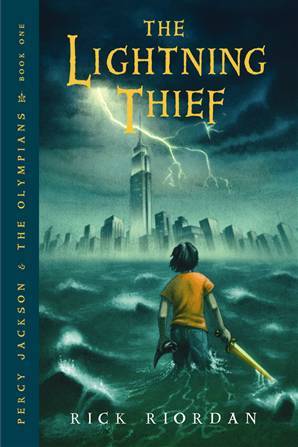
The Lightning Thief

Oh, boy, the gods sure are mad. Zeus has just accused Hades of stealing his master lightning bolt (a big no-no) and Hades insist that he is innocent of these charges! Most folks would call a lawyer, but hehe Greek gods do not do that when they get ticked at each other. Instead, they start the equivalent of World War III. What you don't know about this? Hmmph. Not exactly up on current affairs are you? Well, neither is troubled twelve year old Percy Jackson. In fact, he doesn't even believe that the gods are real, but when he learns that his absent father is a god (making Percy a Half-Blood), lands at a summer camp for his demigods, and is tasked with retrieving Zeus' bolt, Percy quickly gets up to speed on things. With his new friends, Grover and Annabeth, Percy sets off on a cross country trek that is fraught with peril and battles with all sorts of cool mythological creatures en route to putting a stop to the gods' pending war.
I have had several people (including Scott and Penguins Quack) recommend the Percy Jackson series to me. Thanks, guys! I loved The Lightning Thief, the first book in that series, and have already reserved the second one. I love mythology, so I am proud of author Rick Riordan, a former teacher of Greek mythology, for introducing younger readers to all of the great characters and stories of Greek mythology with his engaging books. (Riordan's books prove that there is way more to mythology than just characters with crazy, unpronounceable names.) Riordan weaves his allusions to the original myths in well with the modern story; I had a lot of fun guessing which villain was which mythological monster in disguise.

This is a fun book to read in general, though. The plot is action-packed, with frequent confrontations between Percy and the likes of Ares, Medusa, and Chimera, and lots of heart stopping twists and turns. Percy's snarky first person narration is easy to read and is also quite funny. I also enjoyed Riordan's characters - I liked Percy and his pals, and Riordan's characterizations of the mythological characters stay true to form but are still original.

My only problem, and it's a minor one, is that, in true adventure story fashion, there were a couple of parts where I got annoyed at Percy for walking into a trap that I thought was obvious. It wasn't angry annoyance though, so much as sympathetic "Percy, what are you doing? No! Don't do that! What's the matter with you? No!" annoyance, and it didn't affect my enjoyment of the story.

The Percy Jackson series is targeted toward junior high kids, but I firmly believe that nobody can outgrow a good book. The Lightning Thief is an exciting, inventive fantasy adventure that you won't put down. (At least, I didn't.) If you love mythology, you'll love Riordan's take on the original tales and enjoy recognizing the characters. If you have never read mythology, this accessible book is the perfect introduction.

~

Next Time: I will review Hemingway's classic Spanish Civil War saga For Whom The Bell Tolls. I am about halfway through it and I start school tomorrow, but I will try to have my review up in the middle of the week, if at all possible.

14 October 2009

Life of Pi


I used to think that being stranded alone on a lifeboat in the middle of the Pacific Ocean would be the worst possible situation to be stranded in. After reading Yann Martel’s fascinating, surreal novel Life of Pi, I stand corrected. Being stranded on a lifeboat with a 450 lb. Bengal tiger in the middle of the Pacific Ocean is definitely the worst possible situation to be stranded in. And this is exactly what happens to Martel’s sixteen year old protagonist Pi Patel.

I love survival stories, but many of the more recent ones I’ve read have been so clichéd. (If I read another story about a band of egotistical teens that get stranded and learn the values of teamwork, I will scream.) Not so with Life of Pi. This is one of the most original books I’ve read in a long time. The plot is pretty outlandish (and at times a touch fantastical) but Martel always keeps it believable and interesting. (I didn’t want to put this book down!) I was really impressed with the skill Martel crafted his plot structure. He breaks the story down into three very different parts and alternates between settings and narrators. Many books I’ve read like this suffer from uneven pacing. (Yes, books suffer from this medical condition. Sadly, there is no cure.) I didn’t have this problem with this novel at all. The first section is a bittersweet, coming-of-age tale that only hints at what is to come. The second part is the meat of the story – Pi’s harrowing, psychological battle of wills with Richard Parker (the aforementioned Bengal tiger) which is intense, weirdly funny, and quite frightening. The third section is a short, sarcastic interview with Pi that calls into question the entire story of his ordeal on the Pacific. Martel weaves back and forth between these disparate elements of the story effortlessly, and each part more than stands on its own. Furthermore, this is one of the best written books I’ve read in a while. Martel infuses his scenes with so much humor, insight, and emotion. His descriptive scenes are wonderfully evocative and his narration often delves into philosophical territory about faith, fear, and survival, without ever being ponderous or cumbersome. This book is an emotional rollercoaster that has you laughing one minute and cringing in terror the next. (I don’t consider myself unduly squeamish, but there is one scene in here involving a hyena and a zebra that literally made me sick to my stomach. It takes an exceptional writer to produce that kind of an emotional response in a reader!)

As impressive as this book is, I think that Pi Patel stands out as Martel’s greatest achievement in this novel. Pi is intelligent, courageous, and sensitive – he always has your sympathy. I must admit: When I first read the plot description on the back cover, which explained that Pi was a practicing Hindu, Muslim, and Christian, I was a bit skeptical. I love to study religions myself, but I thought that sounded gimmicky. After reading the book, however, I realized that Pi’s novel religious beliefs fit him perfectly. One of the scenes that I ended up sympathizing with him the most was actually the one in which his parents and religious mentors desperately try to convince him that his unorthodox beliefs are impossible to reconcile. Many critics compared Pi to the protagonist of Hemingway’s The Old Man and the Sea. Pi reminded me more of Elie Wiesel in Night. I know that’s a strange comparison – Pi is an Indian castaway from the 1970s and Wiesel is a Romanian Jewish Holocaust survivor (and of course, Pi and Wiesel’s religious responses are polar opposites). But Pi’s maturity, wit, and wisdom (not to mention his distinctive, polished, conversational narration) reminded me a lot of Wiesel in Night.

Life of Pi is definitely one of the best contemporary novels I’ve read. Masterfully written, deeply thought provoking, and absolutely captivating, this book has become a modern day classic for a reason. You won’t soon forget Life of Pi.

P.S. Tis the season for Halloween this month, as I am sure that all of you know. I don't celebrate Halloween, but I enjoy being scared senseless and I was going to try to find something suitably spooky for you guys to read. However, I was perusing the Internet yesterday and found a great Halloween reading list on Shmoop that saved me the trouble. (What, you've never heard of Shmoop? *gasp* This is something I shall remedy! Shmoop is a website that features literature and history study guides. Their study guides are amazing [and hilarious.] Shmoop is a fairly new website, but they're adding new features constantly. I highly recommend them.) Shmoop's list features a wonderful assortment of classic horror novels (and poems!) which I either already love (Dracula, Frankenstein, anything by Poe), have been meaning to read and now really want to read (The Picture of Dorian Grey and The Turning of the Screw) or have never heard of and must read pronto (Browning's "Porphyria's Lover." You'll see why when you read the description.) So check out this great recommendation list and be afraid. Be very afraid.

~

Next Week: So far, I’ve been able to spare you guys one of my multiple choice teasers. Well, not this week. I have no idea what I am reviewing next week. I do know it will be either something by James M. Cain or John Le Carre or Lynne Truss's With One More Lousy Free Packet of Seed. I apologize for being so vague, but there is method to my madness. I anticipate that I am going to be attacked with a cruel and unusual amount of homework in the coming weeks, so I am trying to read some shorter novels (and review some of the books I’m reading in World Lit.), so that I can have things to post on and indulge in longer books (Discworld!) during my period of torture, I mean, studies. That’s the plan anyway. We’ll see how my strategy works out.

09 September 2009

Confessions of an Ugly Stepsister


Iris Fisher’s life has been unenviable of late. Her family fled England after the murder of her father and her Dutch mother, Margarethe, relocated Iris and her sister, Ruth, to Haarlem, Holland. Margarethe soon finds work as a maid for an eccentric painter. Within months, the ever so crafty Margarethe has weaseled her way into a marriage of convenience with a prosperous merchant who has a beautiful but very strange daughter named Clara, better known to the world as Cinderella. Or so Gregory Maguire's version of the Cinderella story goes...

I’ve never been a big fan of the Cinderella story. Oh, don’t get me wrong: The underdog side of the story appeals to me, and I love fantasies, but I’ve always had my doubts about the whole “happily ever after” ending. Plus, that plot just has too many holes: What woman in her right mind would marry a man who spent the entire evening dancing with her, but can only identify her based on her shoes? (I’ve always had a sneaking suspicion that Cindy married for money.) With my doubts about the Cinderella myth, I found Maguire’s retelling of the story – through the eyes of one of the ugly stepsisters no less – quite interesting.

One thing I really liked about this book is how well-written it was. Maguire’s narration is witty and eloquent, and he did a great job of writing dialogue that sounds authentically 17th century but is still readable. The precise historical detail really impressed me too – you feel like you’re actually transported back to Holland four hundred years ago. As well told as the story is, the real appeal (for me) was how realistic the characters were. Clever, sensitive, but woefully plain Iris is easy to sympathize with. Although Iris is the heroine, Clara isn’t exactly demonized – she’s bratty and selfish, but she’s definitely not the villain. That honor goes to Margarethe. Margarethe is the a combination of every crass, obnoxious, bossy middle aged woman that you've ever met in your life. She’s terrifying in her authenticity! I actually cringed during scenes that featured her. I also thought Maguire did a skillful job of weaving his subplots in. I usually find the side stories in novels distracting - not so with this book. The depiction of the Dutch Baroque art world is fascinating, and the mysterious, recurrent flashbacks of the Fishers’ flight from England are intriguing. My only complaint: The pacing in the final section (which covers Cinderella’s ball) seemed kind of hurried. After Maguire so methodically and intricately pieced together the background, I thought the resulting climax’s quick pacing seemed a touch abrupt. Then again, Maguire’s take on the ball is so much more logical than the traditional version and the final chapter has such a neat twist, so I can’t complain too much.

I really enjoyed this novel. It's a fun book to read. Maguire did a fantastic job of retelling the Cinderella story while still retaining all of the original elements. I’ve been meaning to read Gregory Maguire's books for a while now. I really hope his other books are as good as this one. I look forward to reading more fairy tales from the "villain's" perspective!